When two or more persons acquire a vessel jointly in Panama, the relationship between them does not rest on the free will of the parties: Law 55 of 2008 on Maritime Trade establishes a specific regulatory structure that governs rights, obligations, and decision-making mechanisms from the moment the parties establish boat co-ownership. For this reason, understanding those rules before signing any agreement helps avoid potential disputes.
Panama Maritime Law 55 of 2008
Law 55 of 2008 on Maritime Trade governs the legal relations over vessels in Panama. Chapter II sets the rules for when two or more persons share ownership of a vessel: rights and obligations of each participant, collective decision-making mechanisms, and tools for resolving conflicts, all applicable from the start of boat co-ownership.
Property rights in the vessel
Within that regulation, the law establishes that each co-owner may use the vessel, and Article 23 provides that gains and losses are distributed in proportion to each party’s share. For those property rights to take effect against third parties, Maritime Law requires registering the vessel in the AMP Vessel Registry.

Right of first refusal
The right of first refusal is a preferential mechanism: when a participant wishes to sell their share, the remaining co-owners hold priority to acquire it before any outside party. The seller notifies their intention in writing; the other co-owners have three days from that notification to exercise their preference. Once that period lapses without action, they lose the right of first refusal and the seller may transfer their portion to whomever they choose.
Timeshare use vs. ownership
Distinct from boat co-ownership is timeshare use, a regime under which the user pays to use the vessel during fixed periods without acquiring title. The organizer retains full property rights; the user cannot sell nor recover anything at the end of the arrangement. Maritime Law does not govern that scheme.
Voting and relative majority
For collective decisions, Article 18 sets relative majority as the default rule: it is enough that more participants are in favor than against, without requiring 50%+1. When there are only two co-owners, the one with the larger share decides; if both shares are equal, a judge resolves the matter. To modify the terms of the accord or appoint an external administrator, Maritime Law requires unanimity.
Co-ownership Agreement: Clauses
The law establishes minimum standards; the boat co-ownership agreement covers what the regulation does not specify in detail. That document organizes shared use among vessel owners and anticipates practical scenarios. Without a written version, any dispute gets resolved solely by what Maritime Law provides by default.
Shared use and schedule
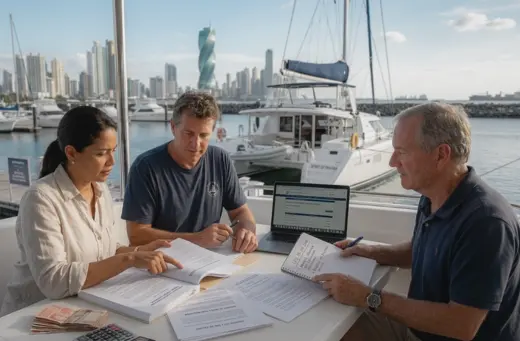
The boat co-ownership agreement must set the timeshare use for each participant, the mooring location, and the procedure for modifying the schedule. Putting that in writing from the outset prevents the most common friction points between titleholders.
Maintenance and reserve fund
Article 21 requires each co-owner to contribute to expenses in proportion to their share, but it does not detail how to handle unforeseen costs. The accord must establish a reserve fund, set the threshold for approving major repairs, and define who oversees disbursements.
Disputes, repairs, and dissolution
If the minority refuses to participate in a repair approved by the majority, they must transfer their share to the other co-owners, who may accept it through an expert appraisal or request a judicial sale of the vessel. A mediation clause allows the parties to attempt a negotiated resolution before reaching that stage. In the event of an irresolvable disagreement, any co-owner may seek a judicial sale of the vessel.
Expenses and guarantee for non-payment
When a participant does not cover the agreed expenses, the other vessel owners may demand that debt stand as a guarantee against that participant portion of the vessel. The mechanism functions without an immediate judicial process.
Vessel Owners Registry
Once the accord is drafted, the step that gives it validity against all parties is the formal registration. Maritime Law requires vessel owners to submit their titles to the Vessel Registry of the Panama Maritime Authority (AMP). Without that registration, the boat co-ownership agreement produces no legal effect against third parties.
Documents for registration
Article 16 admits a public deed or a private document with a signature authenticated before a notary or Consul. That document must identify each titleholder, their percentage, and the subject of the accord, and must be submitted with an apostille to the AMP’s Vessel Registry.
Registration options
The participants must decide whether to register boat co-ownership as direct titleholders or through a legal entity. That choice affects the transfer of shares, liability to third parties, and the administration of the vessel. Some of the most commonly used structures are:
- The LLC centralizes management and allows the transfer of participations without modifying the naval title, limiting each partner’s liability to their contributions.
- The IBC Corporations issue actions on the ship that facilitate the transfer of shares and allow the identity of the partners to remain confidential.
Legal Advice for Flagging your Ship
Formalizing a boat co-ownership agreement in Panama involves some specific decisions: drafting a customized agreement that includes a timeshare use, selecting the registration structure, and completing the filing with the AMP’s Vessel Registry. Kraemer & Kraemer assists with ship registration in Panama and all proceedings before the PMA. Contact us to evaluate your case.