Panama maritime activity is an indisputable engine of its economy, representing 31% of the country’s GDP. An industry that generates investment and employment opportunities, it stands out for its connectivity and innovation. However, beyond the imposing fleet and influential routes, there are specific and non-negotiable elements in Panamanian maritime law, such as the ship radio license. But what makes this authorization so important for safety and operability in Panama’s naval environment?
In this article we will explain the legal and functional implications of this procedure, the requirements of the ship radio license and why having it is not only an obligation, but an endorsement in international navigation and in Panamanian waters.
What Is a Ship Radio License and Why Is It Required?
To begin with, a ship radio license is an authorization that allows vessels and yachts to use radio frequency equipment. Its main purpose is to facilitate maritime communication, which contributes to safety and the proper monitoring of regulations throughout the trajectory.
This document, issued by the Panama Maritime Authority (AMP) and regulated by Law 57 of 2008, certifies that the vessel maintains continuous contact with the port of departure, can report navigation conditions, and receive instructions — especially during emergencies. Furthermore, this maritime license is mandatory at the time of sailing, as it confirms that the ship’s communication system complies with all established regulations, including the GMDSS.


Navigation Patent and Communication Standards
In addition to the above, sailing legally under the Panamanian flag requires meeting several documentation requirements. Two of the main ones are the Navigation Patent and the Ship Radio License. While these are independent processes, they are closely connected because both are essential for registering and operating a vessel or yacht.
The patent, for its part, certifies that the vessel or yacht is authorized to navigate internationally under the Panamanian registry, while the ship radio license allows the legal use of communications equipment on board, following international maritime safety regulations. Both documents are issued quickly as part of the facilitated procedure offered by the Panama Maritime Authority.
Special Considerations for the Canal Zone
The Panama Canal Zone is important for world trade, and therefore has its own rules of the game. Here, the ship radio license requirements are very clear and must be followed to the letter. Any ship that wants to cross this route has to report as accurately as possible its data, providing details such as its length, draft, the type of cargo it is carrying and the estimated time it will take to pass. For this to be possible, it needs to have certified equipment and all permits in order.
Canal Zone managers are always on the lookout, with stations set up to handle maritime traffic. For example, small craft must use channels 12 (156.600 MHz), 13 (156.650 MHz) and 16 (156.800 MHz) while navigating in Canal waters. Without a ship radio license to support maritime communication, they would simply not be officially recognized.
Radio License Requirements and Process
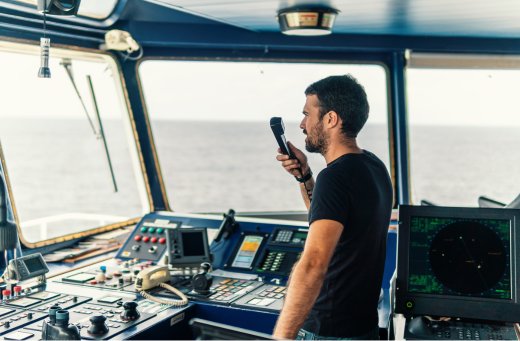
Applying for a ship radio license involves the submission of forms, certifications and legal documents. These must be accompanied by payments defined according to the type and tonnage of the vessel. Panama authorities check that all devices are compatible with the radio frequency service and that they are in good condition.
Ship radio license requirements in Panama:
- The ship must be in good standing with the corresponding taxes and fees.
- The equipment must correspond to the tonnage and navigation area.
- Technical documents in force.
- INMARSAT radio license application form duly completed.
- Any other document requested by the Directorate General of Merchant Marine.
- Proof of payment of the applicable fees.
- B/. 200.00 for the Regular License.
- B/. 150.00 for the Provisional License.
- B/. 4.00 of stamps.
Provisional License for Radio Navigation
During the process of Panama ship registration (or flagging), a temporary permit is issued that allows vessels to operate under the flag on a transitory basis while the official enrollment is completed. At this stage, the provisional license of radio (for 3 months) and the temporary navigation patent (for 6 months) are granted.
In the case of a ship registration under construction, the Panama Authority (AMP) assigns the radio letters. This unique identifier allows the vessel/yacht to be recognized and identified by other vessels, coastal stations or maritime authorities through radio communication systems.
Permanent License for Radio Navigation
Upon completion of all registration requirements, the vessel/yacht may receive the statutory license. This ship radio license is valid for a longer period, usually four to six years, and requires the ship to have a valid navigation patent.
Getting Support from Panama Maritime Experts
Applying for a ship radio license in Panama does not have to be a complicated process. If you are looking for your vessel or yacht to comply with all requirements and maintain accurate and secure communication, the support of specialists is indispensable. At Kraemer & Kraemer, we understand the importance of this document for your maritime operations. Contact us today to help you manage the legal formalities related to navigation and maritime law in Panama.