The captain’s license renewal process must be completed every two years for domestic navigation, or every five years for international navigation. During this process, the Panama Maritime Authority (AMP) does not require applicants to prove their eligibility requirements from scratch, but rather to submit certain documentation to verify that their medical and professional capabilities are valid, that they have recent work experience, and that their competencies correspond to their current level.
The captain’s license renewal involves submitting application forms, a medical certificate, proof of maritime experience, up-to-date safety course certificates, and payment to the General Directorate of Revenue (DGI). There are also technical requirements that vary depending on the license category and type of navigation. The Directorate General of Seafarers (DGGM) reviews the application and, when everything is in order, brings the license up to date.
Revalidation vs. Initial Issuance
The initial issuance and renewal of a captain’s license are mandatory steps for sailing legally; both processes have certain similar but not identical requirements. During the initial application, you demonstrate for the first time that you have the required training.During the preliminary formality, the Directorate General of Seafarers (DGGM) verifies that your competence certificates are up to date and that you have not committed any violations that would affect your authorization.
Types of National and International Waters Licenses
Before starting any paperwork, confirm which category of license you hold. The AMP, as the body that regulates national seafarers, issues licenses for international waters and national waters, and the conditions for each differ from one another.
On the one hand, local navigation credentials apply to vessels operating within Panamanian jurisdiction. For a seafarer in this category, renewing a captain’s license involves completing the Maritime Safety Course for National Waters, among other requirements.
The International Convention on Standards of Training, Certification and Watchkeeping for Seafarers (STCW 78, as amended) governs the international waters license, also known as the STCW license. The International Maritime Organization (IMO) administers that agreement. Holders of this credential must present competence certificates aligned with its provisions.
If you are not sure which type of maritime license you hold, check the document that the DGGM issues, since it states the category there.

Captain’s License Renewal: Step by Step
The process to revalidate your captain’s license before the Directorate General of Seafarers runs from updating the courses that the Panama Maritime Authority (AMP) requires to the digital registration on the official platform. Below, find the five main steps to complete your captain’s license renewal:
Step 1: Obtain the Competence Certificates and Course Approval Certificates
The initial step of the captain’s license renewal is gathering the competence certificates that correspond to your type of license. The DGGM demands that these papers stay current at the time you submit the request.
- First Class Fishing Master: Course approval certificates for IMO courses 1.19, 1.20, 1.21, and 1.13, from facilities that the AMP recognizes.
- Other categories: Either a training center that the AMP approves issues the course approval certificate for the National Waters Maritime Safety Course, or a technical officer of the institution gives it during national waters tours.
- Holders of the international waters license: Competence certificates that prove compliance with the STCW license. The IMO sets the minimum standards, and the DGGM checks that each course matches the level of the certification you are renewing.
Step 2: Handle the Medical Certificate
The captain’s license renewal requires a medical certificate that a licensed Panamanian doctor completes. This paper confirms that you keep the physical and mental fitness to perform duties on board.
The medical certificate carries a validity of three months from its issue date. Handle it close to when you plan to submit the request, so it does not expire before the DGGM processes it. Bring this document in original form with the seal and signature of the professional, as well as that of the healthcare institution, clinic, or hospital where it was issued.
Step 3: Gather the Base Records
The medical certificate and the proof of competence are not the only elements of the file. For the captain’s license renewal, you also need:
- Form F-76 (Application for Technical Documentation of Seafarers), available on the AMP portal.
- A recent 4×4 cm photograph.
- A copy and original of your identity card or valid passport.
- Your previous license.
Check that you have filled out the forms completely before attaching them. Requests with missing data come back to you and cause delays in the captain’s license renewal.
Step 4: Submit the Request Through the SAA System
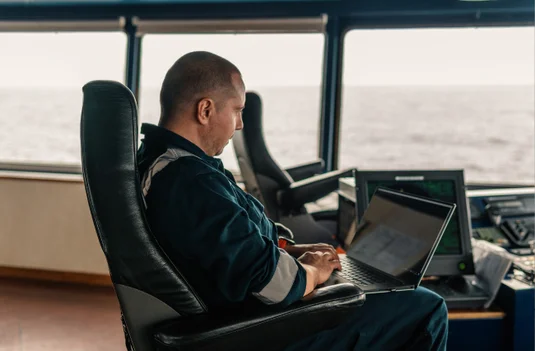
The DGGM put in place the Automated Applications System (SAA), the official platform to register technical documentation submissions for seafarers. Through this tool, you add the records from the previous steps and generate the digital file for your revalidation.
When you submit your request in the SAA, confirm that each attachment stays legible and that the data on the forms matches your identity papers. The Titling Department examines the dossier for the captain’s license renewal and notifies you if it finds any inconsistency.
Step 5: Pay the Fee and Confirm the Request
Once the DGGM validates the paperwork, you must settle the fee that applies to the captain’s license renewal. The sum varies according to license type and nationality, and payment takes place mainly at AMP offices nationwide.
Although the base amount differs for local and foreign applicants, the fee is the same for licenses covering international and domestic waters. In other words, the DGI sets the fee based on the seafarer’s nationality but does not distinguish by category or type of navigation. After this step, the DGGM handles the submission under Resolution J.D. 053-2018.
Do You Need a Duplicate License?
If you lose or damage your original certification before its term runs out, the AMP allows you to arrange a duplicate before completing the full captain’s license renewal. Submit that paperwork through the SAA with the documentation that matches this option.
The validity of this replacement does not extend past the expiration date of the initial certification. If you hold an international waters license or a national waters credential nearing the end of its validity, start the renewal directly rather than request one.
Ongoing Duties
Keeping the permit in force goes beyond meeting revalidation deadlines. Between one cycle and the next, the competent authorities at National Ports carry out random alcohol and drug tests. Any adverse findings may lead to suspension of the license, regardless of its validity.
The captain’s license renewal updates the documentary certification, but conduct rules govern the seafarer throughout his entire active career.
Get Expert Guidance for Your Maritime License Renewal
If you wonder how to get ship captain license or need to confirm that your revalidation filing strictly meets every AMP regulation, Kraemer & Kraemer has a team of maritime lawyers in Panama ready to assist you. Contact us today and secure the validity of your credentials with the backing of expert professionals.